How Much Food Should You Order for 20, 50 or 100 Guests?
A tray that “serves ten” can mean ten lunches or ten side portions. Work through meals, snacks and drinks for 20, 50 and 100 guests, with the assumptions made clear.
By Seow Lin · 18 September 2026 · 9 min read
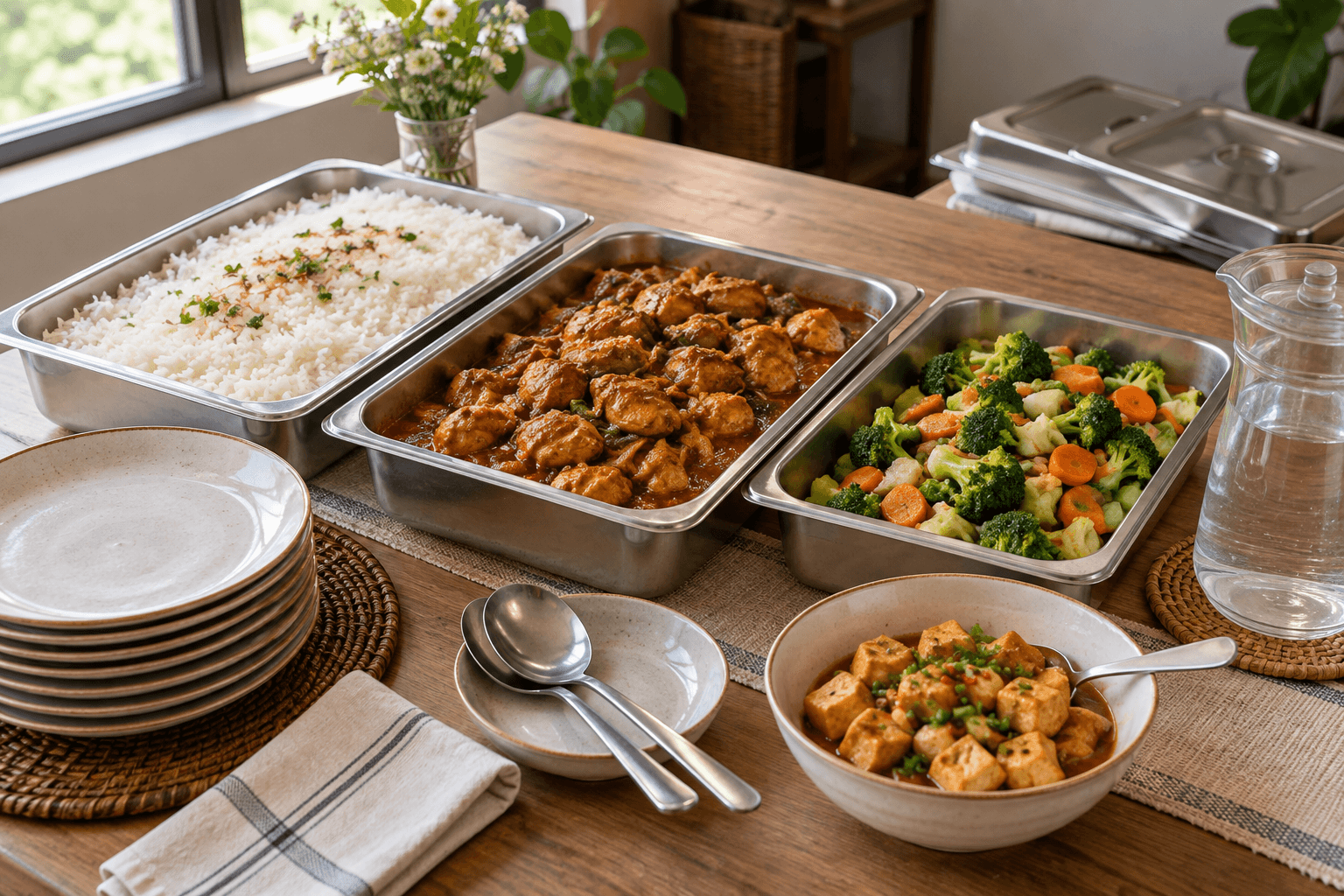
You have fifty people coming, and a tray says it serves ten. Five trays should do it. But ten people eating what: a full lunch, a side dish or a small helping alongside three other dishes?
That missing detail makes food quantities harder to compare than they should be. Before multiplying anything, establish what a portion means and whether your guests are expecting a meal or something to nibble.
For a full lunch, start with 20 complete meals for 20 diners, 50 for 50, or 100 for 100, before deciding on any extra portions. For an afternoon gathering, work in actual snack pieces instead. When several vendors are involved, decide which food makes up the main meal before adding the extras.
The examples below cover 20, 50 and 100 guests. They are planning scenarios, not vendor quotations or interview findings. Use the calculations with portion sizes confirmed by your chosen caterer, rather than treating them as a universal food-per-person rule.
Count the people who will actually eat
Start with confirmed attendance for the meal, not the total number of invitations. Include hosts, organisers and anyone working at the event who needs food. Keep those groups visible so a photographer’s lunch does not come out of the guests’ order by accident.
Record dietary meals within the total. If twenty people are eating and three need vegetarian food, that is seventeen standard meals plus three vegetarian meals. It becomes twenty-three only if you deliberately order extra.
For children, give the caterer the ages and number attending. A toddler and a hungry teenager should not disappear into the same half-portion calculation. Ask what the menu provides for them and how those portions are charged.
Finally, put the meal time and duration beside the headcount. Lunch at noon and refreshments at 3pm are different orders even when the same people attend.
Ask what “serves ten” actually means
Before deciding how many trays to order, get answers to these questions:
- Is the serving estimate for a complete meal, or for one dish eaten alongside the rest of a menu?
- How many portions or pieces are in the tray, and what size is each portion?
- If the menu includes rice and noodles, are guests expected to choose one or take a smaller helping of both?
- Are protein portions counted as pieces, weight or servings? Does the dish contain bones?
- Does the quoted headcount already include any spare portions or allowance for seconds?
- How are dietary meals portioned and kept available for the intended guests?
A description such as “large tray” is not enough. Even tray dimensions do not tell you how deep it is filled or how much each guest is expected to take.
Once the serving basis is clear, the arithmetic is simple: portions needed for that dish ÷ confirmed portions per tray, rounded up to a whole tray where necessary. The important part is the confirmed portion size, not the formula.
For 20 guests: work out a full lunch
Assume twenty adults are attending a lunchtime gathering, including the host. Three are vegetarian. There are no additional crew meals, no other main-food vendor and no unconfirmed guests in this example.
- Meal boxes: seventeen standard lunches plus three vegetarian lunches gives twenty complete meals.
- Shared dishes: ask the caterer to build one lunch for twenty across the rice or noodles, mains and vegetables, with three complete vegetarian portions reserved.
- Dessert: if you want one serving each, request twenty servings. If cake is already arranged, count it as the dessert before adding another.
- Drinks: provide drinking water and decide whether you also want a separate drink with lunch. Check its actual volume rather than relying on the phrase “drinks included”.
For a tray example, suppose the supplier confirms that one rice tray gives ten lunch portions alongside the proposed mains. Two trays cover twenty rice portions. That does not tell you how many chicken, tofu or vegetable trays to buy; each has its own serving basis.
If you add a noodle dish, do not automatically keep enough rice for twenty full rice portions and add twenty full noodle portions too. Tell the caterer whether guests will choose between them or sample both, then ask for the combined starch quantity.
Now suppose two helpers also need lunch. Change the total to twenty-two. For boxes, two extra meals may be possible. For trays sold only in ten-portion sizes, ask whether a smaller top-up is available before rounding every dish up to thirty.
For 50 guests: plan an afternoon spread in pieces
Assume fifty adults are coming from 3pm to 4.30pm, have eaten lunch and have been told to expect light refreshments. This is not the right brief for a gathering that starts at noon or continues through dinner.
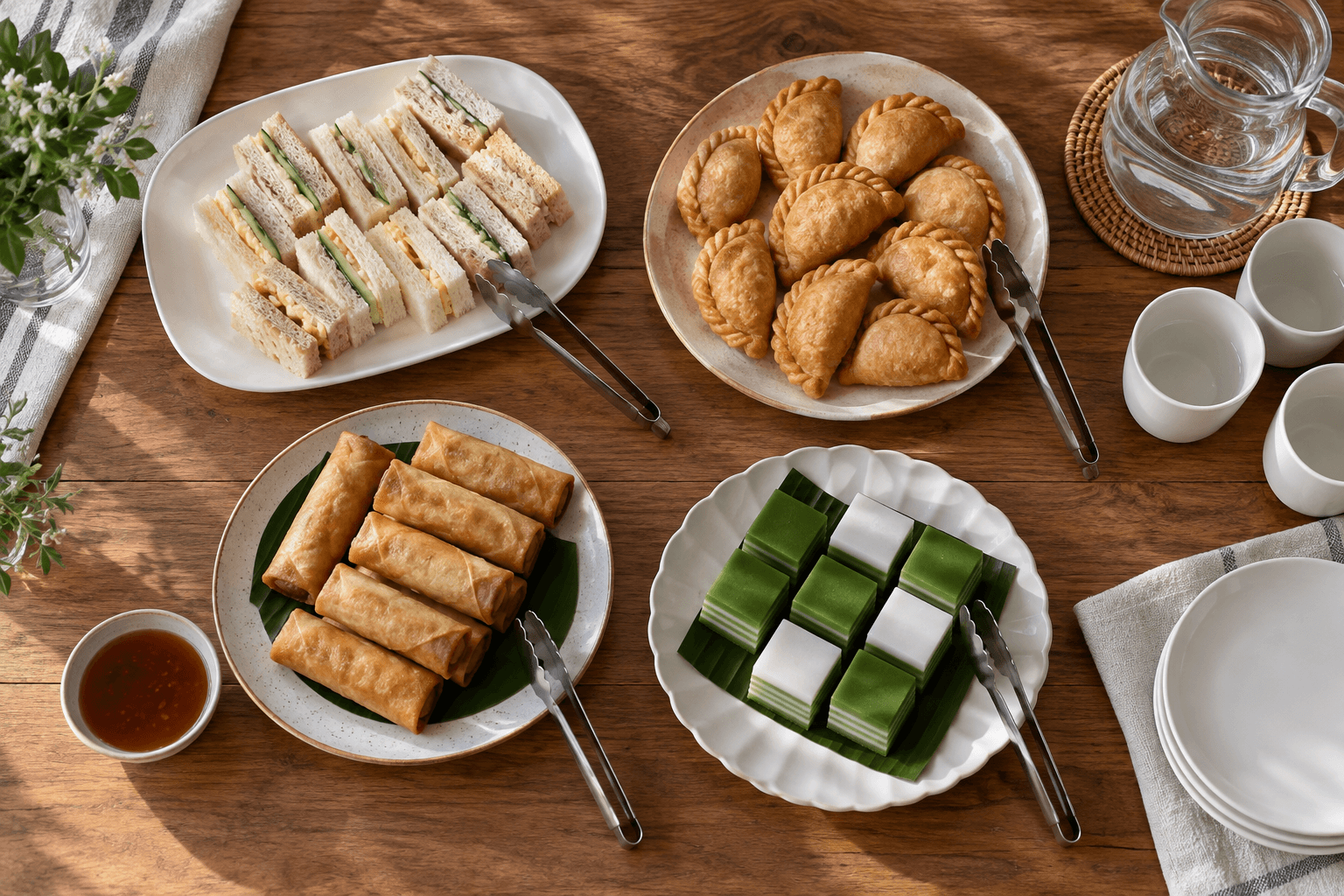
As a sample menu to discuss with the caterer, plan one mini sandwich, one small curry puff, one spring roll and one piece of kuih per guest:
- 50 mini sandwiches.
- 50 small curry puffs.
- 50 spring rolls.
- 50 pieces of kuih.
- Total: 200 snack pieces, made up of 150 savoury and 50 sweet pieces.
Four pieces per guest is the assumption for this particular example, not a general catering recommendation. Check the actual sizes with the supplier. Four tiny canapés and four substantial pastries are very different amounts of food.
Pack sizes change the order too. If the curry puffs come in packs of twelve, fifty pieces would require five packs, giving sixty. Decide whether to accept the ten extra pieces or adjust the menu before rounding up every item in the same way.
Build dietary alternatives into those counts. If five guests need a different savoury item, reserve suitable replacements for them rather than adding a few unlabelled snacks to the shared table and hoping they last.
If the guest brief changes to “come for lunch”, replace the snack calculation with complete meals. Making the afternoon spread larger without reconsidering the menu can leave you with plenty of pastries but no proper lunch.
For 100 guests: give each vendor a clear role
Several vendors can make an event feel generous, but it is easy to order several complete meals for every person without noticing. A rice meal, a full noodle bowl, snacks and dessert are not automatically four things each guest will finish.
Assume one hundred adults are attending lunch. They choose their main in advance: sixty choose a rice meal, thirty choose a noodle meal and ten need a vegetarian meal.
- Rice-meal vendor: 60 complete meals.
- Noodle-meal vendor: 30 complete meals.
- Vegetarian meals: 10 complete meals, assigned to a supplier that can meet the requirements.
- Total mains: 100 complete meals, with each guest counted once.
- Dessert: if everyone is offered one, plan 100 dessert servings across all dessert suppliers, not 100 from each.
This split works because the choices are known. If guests can choose freely on the day, a sixty-thirty-ten split does not guarantee that the popular station will last. Ask the vendors to propose the mix and a backup plan, or use pre-orders or meal tokens to make the quantities manageable.
For a tasting-style event, tell every vendor that guests will eat from several stations. Ask for smaller tasting portions and check that the combined selection makes the meal you promised. Do not order full meals from each vendor and assume the presence of more stalls will make people eat them all.
Service speed matters as well as quantity. If all one hundred lunches must be served in thirty minutes, the combined service needs to average at least two hundred meals an hour during that window. That is a throughput calculation, not a claim about any station’s capacity. Each vendor still needs enough capacity for the guests choosing its food, with room for a rush.
Turn drinks into litres, cups and refills
Ask how many litres of ready-to-drink beverage are supplied, how much goes into each cup and whether ice is included in that cup size. A dispenser’s capacity is not necessarily the total amount of drink ordered.
For a simple calculation, suppose you want one 200ml serving of a particular drink per guest, measured as liquid before ice:
- 20 guests: 20 × 200ml = 4 litres for one round.
- 50 guests: 50 × 200ml = 10 litres for one round.
- 100 guests: 100 × 200ml = 20 litres for one round.
Two planned rounds would double those figures. These are serving-volume calculations, not estimates of how much fluid anyone needs for the day. Keep drinking water available separately and discuss refills, event length, weather and activity with the caterer.
If you also have coffee, tea or another drinks vendor, decide how those options share the order. Ask whether “refills” means extra drink is supplied or someone will refill the dispenser from the same fixed stock. Count cups or arrange washing and reuse as appropriate.
Choose a buffer for a reason
Extra food can be useful, but a blanket percentage is not a substitute for knowing who is coming. Five uncertain RSVPs, two crew meals and a group likely to want seconds are different things to plan for.
Put the known meals in the main count. List uncertain attendees separately, ask when the order can be changed and check whether the caterer already builds in an allowance. Then decide where extra portions would help most.
For example, if three people may join a twenty-person lunch, ask how to add three complete meals or an equivalent shared-food top-up. That is a clearer request than adding more rice while leaving the mains unchanged.
If you run this event regularly, note what was left and what ran short. The US EPA’s food-waste guidance recommends using information about waste to improve menus and portions. Your own event record can help you place a more accurate order next time.
Send one quantity brief before you confirm
Give each supplier the same event context, including what the other vendors will serve. You can adapt this message:
We have [number] people eating at [time], including [dietary breakdown]. This is a [full meal / light afternoon spread / tasting event]. Other food will be [details]. Please confirm what one portion means, how many portions or pieces each tray contains, and whether your quantities already allow for seconds. For drinks, please state the total litres and cup size. We also need your final-headcount deadline and minimum quantities per item.
Keep their answers with the final order. For each dish, record the number of portions, the number of trays or packs, and who it is intended for. That makes it easier to check the delivery and avoids asking a colleague to interpret a vague “food for fifty” message on the day.
On GatherPlate, use current menus and service options to build your shortlist, then confirm the portion details for the food you choose. Meal boxes and sets can make individual meal counts straightforward; shared spreads need a little more discussion about how the dishes fit together.
The aim is not to find a magic number for twenty, fifty or a hundred people. It is to know what each person is being offered, what each tray actually contains and where an extra helping will come from if you need it.
The worked examples are illustrative, not vendor recommendations or tested serving guarantees. Confirm portion sizes, dietary arrangements, pack minimums and quantities with your chosen caterer. Images are AI-generated illustrations, not photos of real vendor orders or evidence of serving quantities.