“No Pork, No Lard” Is Not Halal: Catering for Mixed-Faith Guests
A caterer says “no pork, no lard”. A guest asks whether it is halal. Those are two different answers, and since June 2026 Selangor treats the difference as a legal one. Here is what the phrase covers, what certification adds, and what to confirm before you book.
By GatherPlate Team · 20 September 2026 · 13 min read
You have found a caterer for the office lunch. The menu looks right, the price works, and the website says “no pork, no lard”. Then a colleague asks the only question that matters to half your guest list: is it halal?
No. “No pork, no lard” is not halal certification. It is a statement about two ingredients. Halal certification in Malaysia is an audit of an entire kitchen, issued by JAKIM or a state Islamic religious authority. A caterer can be truthful about the pork and still be unable to serve a guest who eats only certified halal food.
That gap used to be a matter of judgement. In Selangor it is now a matter of enforcement. This guide covers what the phrase actually tells you, what changed in June 2026, and the questions that settle it before you pay a deposit.
What “no pork, no lard” actually means
The phrase is a description of absence. The kitchen is telling you it does not cook with pork meat and does not use lard as a cooking fat. In Malay you will see it written as tiada khinzir, tiada lemak babi, and the common search for its maksud returns the same narrow answer: two ingredients, nothing more.
It became common because it is useful shorthand. A non-Muslim owned restaurant that wanted Muslim customers needed a way to say “you can probably eat here” without going through certification. For a casual meal between friends, plenty of people accept it.
An event is a different situation. You are ordering on behalf of other people, some of whom you will never speak to, and you are the one who will be asked where the food came from.
Here is what the phrase leaves unanswered:
- Slaughter method. Chicken and beef can be entirely pork-free and still not be slaughtered according to Islamic rites.
- Alcohol. Cooking wine in a marinade, mirin in a glaze, rum in a dessert and vanilla essence in a cake are all common, and none of them involve pork.
- Gelatine and emulsifiers. Panna cotta, marshmallow, mousse and some cheeses can carry pork-derived gelatine even when no pork is served as a dish.
- Cross-contamination. Shared fryers, shared chopping boards, one set of tongs across a buffet line, and a delivery van that carried a different order that morning.
- Suppliers. A kitchen can be careful and still buy from a supplier who is not.
- Who checked. Nobody from outside the business has verified any of it.
None of that makes a “no pork, no lard” caterer dishonest. It makes the label incomplete for the decision you are making.
Selangor now restricts the phrase
On 5 June 2026 the Selangor Islamic Religious Department (JAIS) said that food businesses without Malaysian halal certification may not display “no pork, no lard” or describe themselves as “Muslim-friendly”. The reasoning is the list above: the signs address one risk and stay silent on the rest.
The legal basis cited is paragraph 4(1) of the Trade Descriptions (Halal Certification and Marking) Order 2011, which makes it an offence to offer food using any representation likely to mislead someone into believing it is halal. Reported penalties under the Trade Descriptions Act 2011 run to RM250,000 for a company’s first offence and RM500,000 for repeat offences.
Selangor is not the first state to move. In February 2025 Sarawak barred restaurants without halal certification from using Ramadan-linked terms in their marketing. The direction of travel is consistent: informal reassurance is being pushed out, and certification is the claim left standing.
The ruling is not universally welcomed. In August 2025, Dominic Lau of Gerakan argued that consumers already understand the phrase and read it as information rather than as a halal claim. That debate is real and unresolved. It does not change what you should do as an event organiser, because your guests are not a debate.
A practical read for anyone booking in the Klang Valley: if a Selangor caterer is still leading with “no pork, no lard” or “Muslim-friendly” in 2026, treat that as a prompt to ask about their certification rather than as an answer to it.
What halal certification actually audits
Malaysian halal certification (Sijil Pengesahan Halal Malaysia) is issued by JAKIM at federal level, or by the state Islamic religious council for businesses certified at state level. It is assessed against the national standard MS 1500, most recently revised in 2019.
The important difference is scope. The certificate does not approve a dish. It approves a premises and a process:
- Where the raw ingredients come from, and whether those suppliers are certified
- How the food is prepared and processed, including the equipment that touches it
- Packaging, storage and transport
- How the food is served
- Separation from anything non-halal at every one of those stages
Two details are easy to miss. A certificate has an expiry date, and a certificate has a defined scope. A caterer may hold certification for a central kitchen and not for an outdoor live station, or for one premises and not for a second one opened last year.
You can check a certificate yourself on JAKIM’s Halal Malaysia portal, free of charge. Ask the caterer for the certificate holder’s registered business name, because that is what the directory lists, and it is often not the trading name printed on the menu.
“Muslim-friendly” and “pork-free” are different claims again
These three phrases get used interchangeably and mean different things. “Pork-free” is the narrowest and the most literal. “No pork, no lard” adds the cooking fat. “Muslim-friendly” has no fixed definition at all, which is precisely why JAIS named it alongside the other phrase.
When a caterer uses one of them, treat it as the opening of a conversation. The useful reply is not “is that halal”, which invites a yes. It is “are you certified, by whom, and what does the certificate cover”.
Six questions to ask before you book
- Do you hold Malaysian halal certification, and is it issued by JAKIM or by a state authority?
- What name is the certificate registered under, and when does it expire?
- Does it cover the kitchen that will cook my order, and does it cover on-site service if you are serving at my venue?
- If you are not certified, what is your actual position on alcohol in cooking, on gelatine, and on meat suppliers?
- How will halal and non-halal items be kept apart in transport, on the buffet line and in the serving utensils?
- Will every dish be labelled on the day, and who writes the labels?
Ask them in writing, in whatever thread you are already using to book. A screenshot of a clear answer is worth more on the day than a confident phone call you cannot reproduce.
Question five matters more than people expect. An uncertified caterer who answers it precisely, naming their chicken supplier and confirming no cooking alcohol, is telling you more than a caterer who simply repeats the phrase on their banner.
A mixed guest list: what each group tends to need
Most Malaysian events are mixed by default. The notes below describe practices that are commonly observed here. They are a starting point for a conversation with your guests, not a ruling, and observance varies widely between individuals in every group listed.
Muslim guests
Certified halal is the clear answer, and for a formal or work event it is usually the only answer that avoids putting guests in an awkward position. Where certification is not available, some guests will eat vegetarian food from an uncertified kitchen and others will not. Do not decide that on their behalf, and do not make them announce it in front of colleagues.
Hindu guests
Many Hindu guests are vegetarian. Those who are not commonly avoid beef entirely. Some also avoid onion and garlic, particularly around religious observances. Beef and halal often get conflated here, so be specific: a fully halal buffet built around beef rendang solves one guest’s problem and creates another’s.
Buddhist and Taoist guests
Chinese Buddhist practice in Malaysia often includes vegetarian days, commonly the first and fifteenth of the lunar month. Strict vegetarian cooking, zhai, also excludes the pungent roots: onion, garlic, leek, chives and shallot. Vegetarian catering for a wake or a temple event usually means this stricter version, not a Western vegetarian menu with garlic in the pasta.
Sikh guests
Food served at a gurdwara is vegetarian so that anyone may eat it. Away from the gurdwara, practice varies, and some Sikhs specifically avoid halal-slaughtered meat. This is the one case where “we made everything halal” can be the wrong accommodation, and a vegetarian option is the safer one.
Christian guests and church events
Christian dietary practice in Malaysia places few restrictions on the menu itself. Some guests avoid meat on Good Friday and on Fridays during Lent, and Seventh-day Adventist guests are frequently vegetarian and avoid pork.
The harder question at a church lunch, a Christmas gathering or a fellowship event is usually not about the Christian guests at all. It is about everyone else in the room. Malaysian church events routinely include Muslim spouses, Hindu neighbours, colleagues and invited guests, which puts a church organiser in the same position as an office administrator: sourcing one menu for a room nobody has surveyed.
Vegetarian, vegan and Jain guests
Ask which kind. Vegetarian may still include egg and dairy. Vegan excludes both, and also excludes honey and often gelatine-set desserts. Jain practice additionally excludes root vegetables such as potato, onion, garlic and carrot, which rules out a surprising share of a standard vegetarian menu.
The vegetarian base, and where it stops working
The common advice for a mixed room is to build the meal on a vegetarian base and add meat dishes around it. It is good advice. Grains, vegetables, legumes and fruit sidestep the slaughter question entirely, and a strong vegetarian centre means no guest is eating a side salad while everyone else eats lunch.
It is not a complete answer, for two reasons. Vegetarian food from an uncertified kitchen is still uncertified, and some Muslim guests will decline it. And the vegetarian requirements above actively conflict: an Indian vegetarian menu leans on onion and garlic, and a Buddhist zhai menu excludes them.
So name the constraint rather than ordering “a vegetarian option”. Asking for six portions of onion-free and garlic-free vegetarian food, cooked with separate utensils, gets you something a guest can actually eat.
A worked example: a church Christmas lunch for 80
Eighty guests after a Christmas morning service. The congregation is mostly Chinese and Indian Malaysian. Roughly ten guests are Muslim family members and invited neighbours. Six are vegetarian, two of those without onion or garlic. The budget is ordinary, and nobody has been individually surveyed. This is a constructed example, not a real booking.
Working through it:
- Pork is out, and not as a compromise. With Muslim guests in the room, a pork dish on a shared line contaminates the serving utensils for everyone who cares about it.
- The main order goes to a certified halal caterer if one is free for the date. That single decision resolves the ten Muslim guests without anybody having to ask.
- Beef stays off the main line, or sits as a clearly labelled separate dish, for the Hindu guests.
- Six vegetarian portions are ordered as portions, not as a shared platter that disappears in four minutes. Two are specified onion-free and garlic-free.
- Roast turkey, if you want it, is the part to check hardest. Festive roasts are frequently basted or glazed with wine or brandy.
- Everything gets a label, written before the doors open.
If no certified caterer is free that day, the honest fallback is to say so. Order from the caterer you trust, tell the Muslim guests plainly that the kitchen is not certified, and let them decide. That is a better outcome than a “no pork, no lard” banner doing the talking for you.
Why this gets loudest around the festive season
Deepavali falls on Sunday 8 November 2026, Christmas follows in December, and Chinese New Year and Hari Raya come after that. Every one of those is a festival where a Malaysian host feeds guests from outside their own community, which is why the same question attaches to all four.
Two practical consequences. Certified halal caterers are among the first to be fully booked in festive weeks, so the certification question is worth asking in your first message rather than your fifth. And if you are hosting an open house, the guest list is wider and less predictable than at any other event you run all year.
Frequently asked questions
Does “no pork, no lard” mean the food is halal?
No. It confirms that pork meat and lard are not used. It says nothing about how meat was slaughtered, whether alcohol is used in cooking, whether gelatine is pork-derived, or whether halal and non-halal food share equipment. Halal certification covers all of those; the phrase covers two ingredients.
What does “no pork, no lard” mean in Malay?
It translates as tiada khinzir, tiada lemak babi: no pork and no pig fat. The maksud is literal. It is a statement about ingredients, not a religious certification, and it is not issued or checked by any authority.
Is “Muslim-friendly” the same as halal certified?
No. “Muslim-friendly” has no legal definition and no audit behind it. Halal certification in Malaysia is issued by JAKIM or a state Islamic religious authority against the MS 1500 standard, and it can be verified in a public directory.
Can a caterer in Selangor still display a “no pork, no lard” sign?
Not without Malaysian halal certification. In June 2026 the Selangor Islamic Religious Department said the phrase and the term “Muslim-friendly” may not be displayed by uncertified food businesses, citing the Trade Descriptions (Halal Certification and Marking) Order 2011. Rules differ by state, so check the position where your event is held.
How do I check whether a caterer’s halal certificate is genuine?
Ask for the registered business name on the certificate and look it up on JAKIM’s Halal Malaysia portal, which is free to search. Check the expiry date and the scope, because certification applies to specific premises and processes rather than to a brand as a whole.
Is vegetarian food automatically halal?
Not automatically. Vegetarian food avoids the slaughter question, but an uncertified kitchen may still use cooking alcohol, non-halal gelatine in desserts, or shared equipment. Some Muslim guests accept vegetarian food from uncertified kitchens and others do not, so ask rather than assume.
Can Muslim guests eat at a church event?
The venue is not the issue; the food is. A church lunch catered by a certified halal kitchen, served without pork and without alcohol in the cooking, poses no problem for most Muslim guests. Tell them what was ordered and who cooked it, and let them make their own decision.
One message that settles it
Send the same message to every caterer on your shortlist, so that the replies are comparable:
We are catering for [number] guests on [date] at [venue]. The guest list includes [number] who need certified halal food, [number] vegetarian and [number] without onion or garlic. Please confirm whether you hold Malaysian halal certification, the registered name it is issued under, its expiry date, and whether it covers on-site service. If you are not certified, please tell us your position on cooking alcohol, gelatine and meat suppliers. We also need to know how the dishes will be separated on the line and whether every item will be labelled.
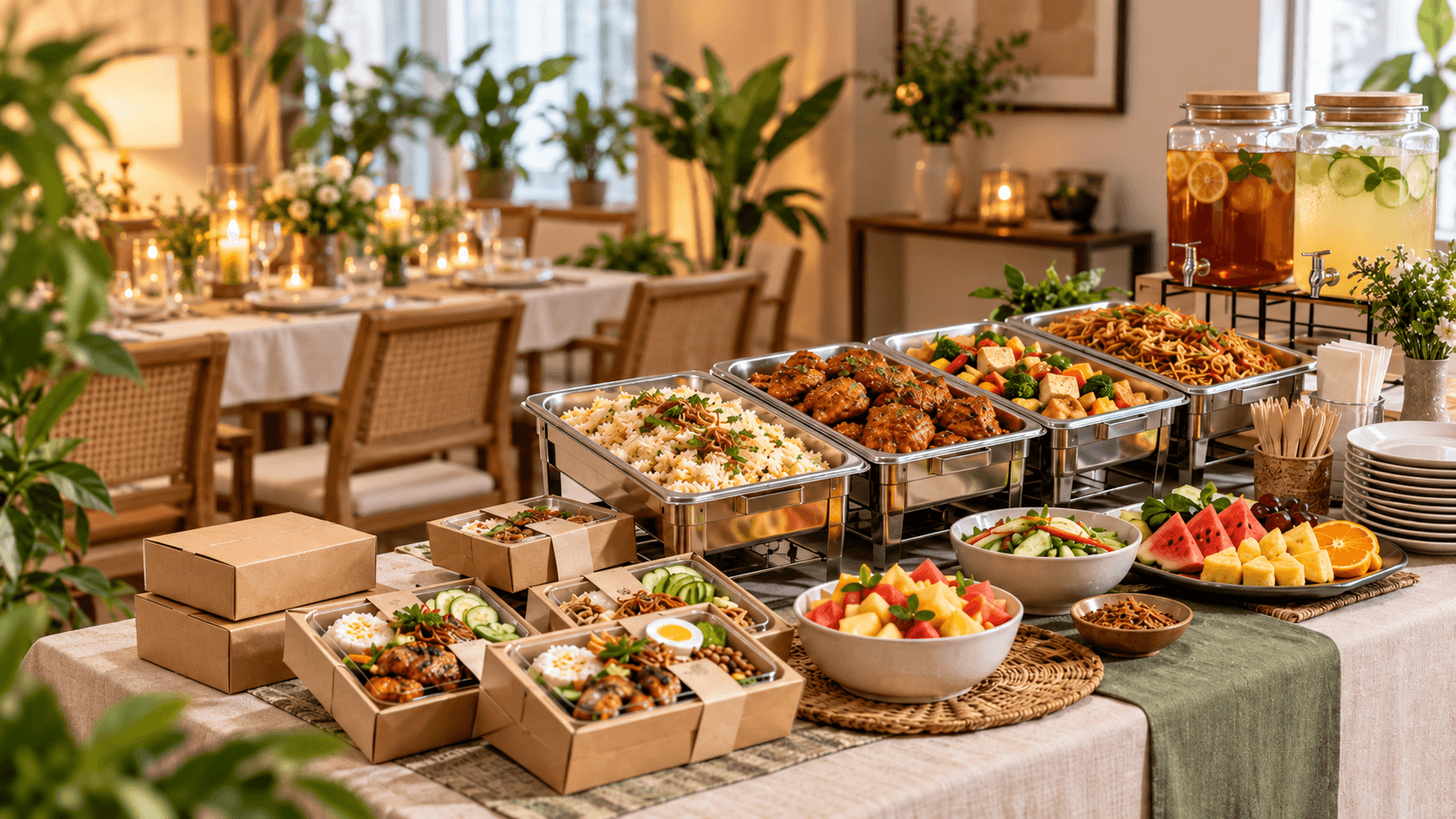
On GatherPlate you can filter for halal caterers or work from a vegetarian or vegan base, and meal boxes keep individual dietary portions separate more reliably than a shared buffet line does. For a festive gathering, open house catering is the category to start from.
The point is not to make every event certified halal. It is to stop a four-word phrase on a banner from making a decision that belongs to your guests.
This article is general information for event organisers, not legal or religious advice. Certification requirements and state enforcement change; confirm the current position with the caterer and the relevant authority. Dietary notes describe commonly observed practice and vary between individuals. Images are AI-generated illustrations, not photographs of real vendors or certified premises.